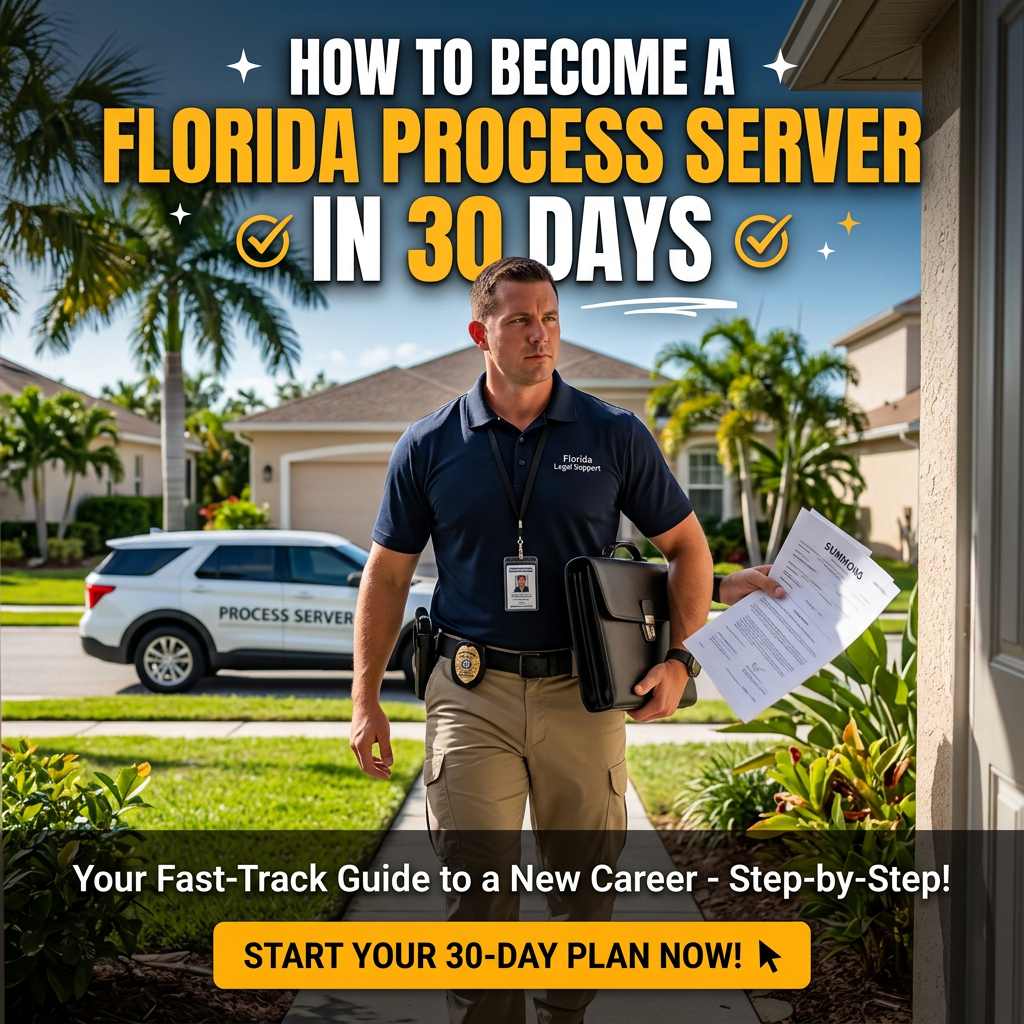
How to Become a Florida Process Server in 30 Days
Florida process servers earn $50 to $200+ per serve, and the work is steady year-round. Lawyers, law firms, collection agencies, and pro se litigants all need someone to physically deliver subpoenas, summonses, divorce papers, eviction notices, and court orders to people who don't necessarily want to receive them. Part-time servers in Florida regularly earn $400–$800 a week. Full-time servers and small process-serving agencies clear $50,000 to $120,000+ a year.
Better still: starting up takes less than 30 days and roughly $500–$700 in upfront costs. Compared to most legal-services side hustles (mortgage origination, real estate, paralegal), the barrier to entry is low and the income kicks in fast.
Here's how to actually do it.
Florida Process Server Facts at a Glance
Florida doesn't have a statewide process server license. Instead, certification happens at the judicial circuit level (Florida has 20 circuits) or the county level. The framework comes from Fla. Stat. §§ 48.25–48.31.
You'll fall into one of three categories depending on where you want to serve:
- Court-Certified counties (40 counties) — Certified by the chief judge of your judicial circuit. Once certified, you can serve initial non-enforceable civil process anywhere in your circuit. This is what most professional process servers pursue.
- Sheriff-Appointed counties (9 counties) — Appointed directly by the county sheriff. Limited to that single county.
- Motion-and-Order counties (14 counties) — No standing certification program. A judge appoints you on a per-case basis.
Most professional Florida process servers go the court-certified route because it covers an entire judicial circuit, including major counties like Hillsborough (Tampa), Orange (Orlando), Palm Beach, Broward, and Miami-Dade.
Step 1: Identify Your Judicial Circuit
Florida is divided into 20 judicial circuits, each covering one or more counties. Your application goes to the Administrative Office of the Courts for your circuit, not to a state agency.
Each circuit has its own application packet, fee schedule, and timing. Some examples:
- 2nd Circuit (Leon County / Tallahassee) — Annual application window with exams typically held in March
- 9th Circuit (Orange/Osceola — Orlando) — $300 application fee, 80% exam pass requirement, $5,000 bond
- 13th Circuit (Hillsborough — Tampa) — Photo ID badge issued, FAPPS course required, swearing-in by chief judge
- 15th Circuit (Palm Beach) — Annual application window October 1 to November 1, swearing-in in January
The takeaway: find your circuit's Administrative Office of the Courts page first. Application timing varies, and some circuits only accept new applicants during specific annual windows — that single fact alone determines whether a 30-day launch is realistic for you or whether you're waiting for the next cycle.
Step 2: Meet the Eligibility Requirements
Common eligibility criteria across nearly every Florida circuit:
- 18 years of age or older
- Florida resident (most circuits; some allow non-resident certification)
- No felony convictions
- No misdemeanors involving moral turpitude or dishonesty within the past 5 years
- No pending criminal cases
- Must be of "good moral character" (which translates to clean fingerprint-based background check)
You'll need a Certificate of Good Conduct as part of your application, and you'll authorize an FDLE (Florida Department of Law Enforcement) fingerprint-based background check that costs around $36.25.
Step 3: Take the FAPPS Course and Pass the Exam
Nearly every Florida judicial circuit requires you to complete a process server training course through the Florida Association of Professional Process Servers (FAPPS). This is the gold-standard training:
- 16-hour course for new applicants
- Available online via Zoom (no need to travel to in-person training)
- Covers Florida statutes, methods of service, due process, affidavits of service, ethical conduct, and skip tracing
- Annual 4-hour continuing education course required for renewals
After completing the course, you'll sit for your circuit's written exam. Passing scores vary — 80% in the 9th Circuit, varying by circuit elsewhere. The exam covers Florida service-of-process law, affidavit preparation, and the rules of conduct for certified process servers.
Step 4: Post Your $5,000 Surety Bond
Every certified process server in Florida must post a $5,000 surety bond with the Administrative Office of the Courts for their circuit. The bond protects the public against improper service or misconduct by the process server.
The annual premium on a $5,000 bond runs $50–$100 depending on your credit. The bond must be issued by a surety company authorized to do business in Florida and name the appropriate judicial circuit as the obligee.
Step 5: Submit Your Application and Get Sworn In
Your completed application packet typically includes:
- The circuit's application form (4 pages in most circuits)
- $100–$300 application fee (varies by circuit)
- Original $5,000 surety bond
- FAPPS course completion certificate
- FDLE background check report
- Certificate of Good Conduct
- Passport-style photos for your ID badge
- Statement of Policy / Process Server Agreement
After review and approval, you'll attend a swearing-in ceremony before the chief judge of your circuit (or your circuit's designated administrative judge). You'll receive a photo ID badge with your Certified Process Server (CPS) identification number. That ID number must appear on every Affidavit of Service you file.
Step 6: Form Your Business and Land Your First Clients
Once certified, you're authorized to serve initial non-enforceable civil process within your circuit. To turn that authorization into actual income:
- Form an LLC (state fee $125 in Florida, plus annual $138.75 report)
- Get an EIN from the IRS (free, 10 minutes)
- Open a business checking account
- Get E&O insurance ($300–$700/year for $1M coverage)
- Set your rate card: $65 standard / $110 rush / $165 same-day / $175+ for difficult/evasive recipients / $95+ for skip tracing
- List with attorneys, family law firms, and process server directories
- Sign up for ServeManager or Process Server's Toolbox for case management
The fastest path to consistent revenue: cold-email solo attorneys and small family law firms in your county. They almost always need a reliable process server, and the per-serve fee margins are excellent.
The 30-Day Reality
Can you actually launch in 30 days? Yes — if your circuit's application window is open and the swearing-in calendar aligns.
A realistic week-by-week timeline:
- Week 1: Identify your circuit, request the application packet, register for FAPPS course, order FDLE background check
- Week 2: Take and complete the 16-hour FAPPS course, sit for the circuit exam, purchase your $5,000 surety bond
- Week 3: Submit complete application packet to your circuit's Administrative Office of the Courts
- Week 4: Attend swearing-in ceremony, receive your ID badge, start cold-emailing attorneys
The gating factor is almost always your circuit's processing speed and swearing-in calendar, not your prep work. Some circuits swear in new process servers monthly; others batch them quarterly or annually.
The Complete 50-State Process Server Guide
I've put together a comprehensive How to Become a Process Server PDF guide that covers Florida's per-circuit certification system in full detail — plus the requirements for all 50 states, so if you want to serve in multiple jurisdictions or expand your business across state lines, everything you need is in one place.
The guide includes a 30-day action plan with weekly checkboxes, an attorney cold-email template that books paid serves in your first week, a complete rate card structure for pricing your services, skip tracing essentials with both free and paid tools, and four exclusive video lessons covering the process server career overview, business blueprint, due process foundations, and skip tracing workflow. It's a 49-page PDF, instant download, $24.99 — the cost of one rush serve, paid back the first time you book one.
Final Thoughts
Florida process serving isn't a get-rich-quick path. It's a legitimate, recession-resistant legal-services business with low startup costs, flexible hours, and clear income potential. Lawyers always need process served. Family law cases happen in every economy. Evictions, subpoenas, and judicial filings don't slow down when the housing market does.
If you're organized, comfortable with confrontation, willing to drive, and can document your work cleanly enough to stand up in court, you can build a $50,000–$120,000 annual business in Florida starting from zero in about a month.
Get certified, build your attorney network, and start serving.
Create Your Own Website With Webador